 UNITY Hardware Ltd. Logo-professional architectural door hardware manufacturer
UNITY HARDWARE / Architectural Buyer’s Guide
A lever handle gets barely a second of attention—until it sags, binds against the lock follower, clashes with adjacent metalwork, or misses the door preparation entirely. Here is how experienced architects and hardware buyers evaluate a commercial handle from the inside out, using specifications for UNITY Hardware’s SR04SL102, SR10SL221, and SR03SL114 series.
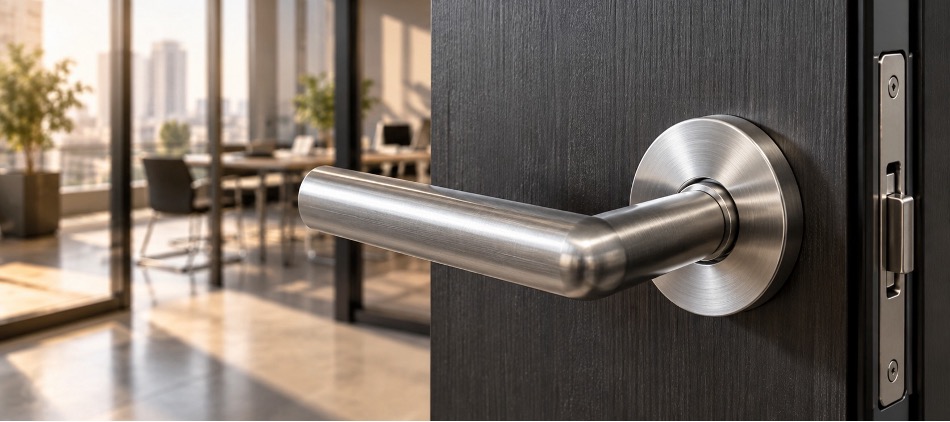
Specification at a glance
Six details that define a commercial lever set
- Rose profile & footprint: Round Ø53 mm (SR04SL102), square 53 × 53 mm (SR10SL221), or narrow oval 70 × 32 mm (SR03SL114).
- Spring arrangement: An unsprung 4 mm rose relies on the lock follower spring; a double-action sprung rose permits upward and downward multipoint-lock operation.
- Sub-rose & fixing architecture: Look for concealed through-bolt fixing, alignment features, and a secure outer-rose connection.
- Critical envelope dimensions: Check rose dimensions, lever lengths of 125–150 mm, and door-face projections of 55–71 mm.
- Base material & finishes: AISI 304 stainless steel; satin US32D/630, polished US32/629, and PVD options. Ask about AISI 316 for corrosive conditions.
- Lock & compliance evidence: Check mortise-lock compatibility, the model-specific EN 1906 classification, and applicable fire-door and corrosion test reports.
When an architect or interior designer reviews an ironmongery submittal, the visible lever grip and outer rose receive most of the attention. Yet many on-site problems originate beneath the trim plate: how the sub-rose bolts through the lock case, how the lever returns to horizontal, and whether the projection clears the frame stop.
01. What Actually Sits Inside the Specification?
The visible lever and outer rose cover are only half the assembly. Behind the clean, screwless elevation sits a mechanical chain that converts hand pressure into latch retraction while keeping the handle secure through repeated use.
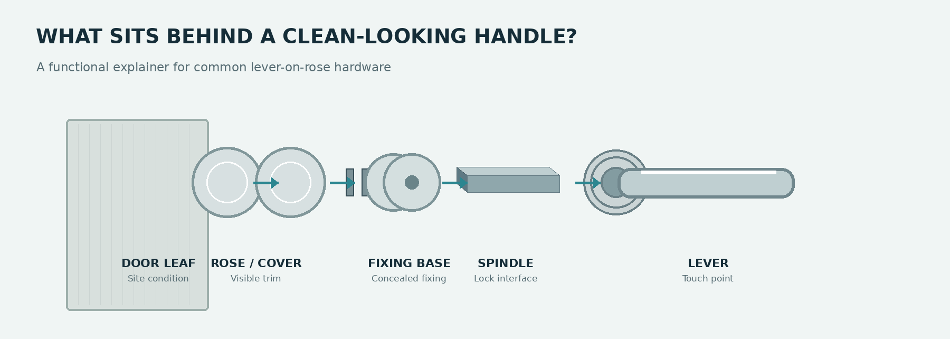
In UNITY’s commercial stainless-steel range, concealed fixing bases incorporate countersunk lugs designed to guide through-bolts through the mortise lock case. Inner-rose features help locate and secure the outer cover without exposed face screws. Confirm fixing sizes and centers on the drawing for the exact model.
02. Start with the Rose: Geometry, Thickness, and Spring Mechanics
The rose is the trim plate surrounding the lever neck. Its footprint, thickness, and spring mechanism dictate where a handle can be installed and how it operates. “Concealed fixing” does not mean all roses are interchangeable.
Why sprung, unsprung, and double-action mechanisms matter
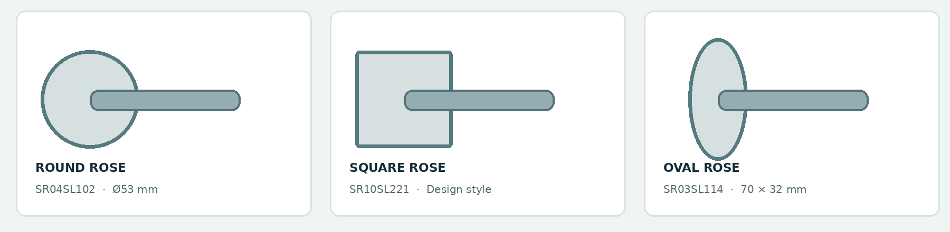
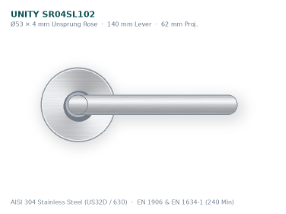
- Minimalist 4 mm unsprung round rose — SR04SL102. The Ø53 mm, 4 mm slim round rose omits an internal return spring. Pair it with a suitable mortise lock follower spring, such as the specified UNITY ML1072 or ML1085 configuration, and verify performance in the actual doorset.
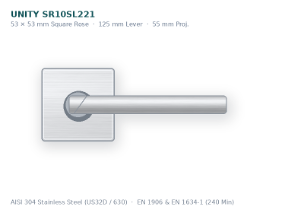
- Aligned square rose — SR10SL221. A 53 × 53 mm square rose creates crisp architectural lines. A dedicated alignment inner rose helps installers achieve a straight, consistent finish, especially in retrofit work.
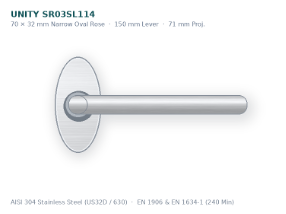
- Double-action narrow oval rose — SR03SL114. The 70 × 32 mm oval rose suits narrow-stile or French doors. Its double-action sprung mechanism supports lever lifting for multipoint locking as well as downward movement for latch retraction.
03. Dimensions: Four Numbers That Prevent On-Site Surprises
Before approving hardware, compare the rose footprint, rose height, lever length, and projection with the door frame, glazing bead, backset, and intended lock case. For SR04SL102, the stated dimensions include a Ø53 mm rose, a 4 mm unsprung rose height, a 140 mm lever length, and a 62 mm projection.
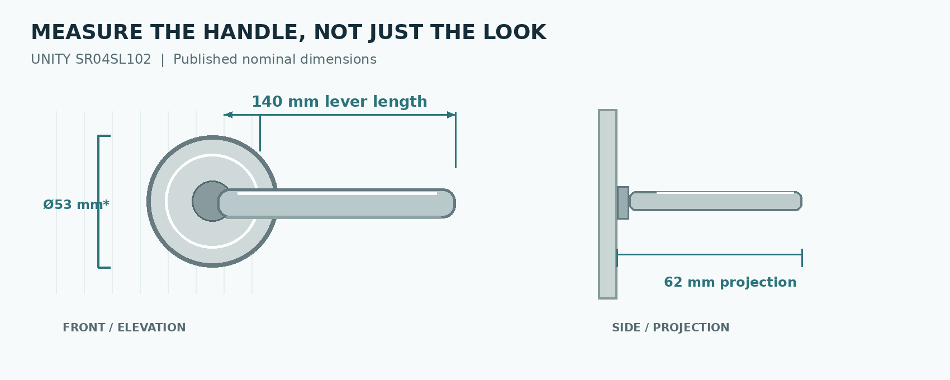
| Dimension | SR04SL102 · Round | SR10SL221 · Square | SR03SL114 · Oval | What it means |
|---|---|---|---|---|
| Rose footprint | Ø53 mm | 53 × 53 mm | 70 × 32 mm | Check stile width, frame stops, and glazing bead clearance. |
| Rose / spring | 4 mm; unsprung | Sprung square rose | Double-action sprung | Unsprung furniture depends on a compatible follower return spring. |
| Lever length | 140 mm | 125 mm | 150 mm | Verify access, leverage, and clearance from adjacent elements. |
| Door-face projection | 62 mm | 55 mm | 71 mm | Verify hand clearance and potential collision points. |
Before installation, cross-check the approved CAD drawing against the lock data sheet, including nominal 8 mm spindle fit, through-bolt centers, supported door thickness, and escutcheon alignment.
04. Metallurgy and Finishes People Actually Live With
Commercial handles are exposed to skin oils, cleaning chemicals, keys, rings, and frequent contact. The featured series use AISI 304 stainless steel, with satin stainless, polished stainless, and selected PVD finishes. AISI 316 should be evaluated where coastal exposure or aggressive cleaning conditions warrant additional corrosion resistance.
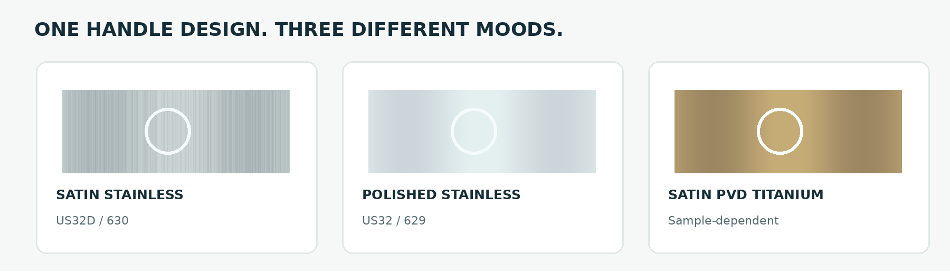
Satin stainless steel offers a restrained appearance and helps minimize visible fingerprints. Polished finishes create a more reflective effect, while PVD titanium offers warmer metallic tones. Review physical finish swatches under project lighting and ensure the escutcheons match the selected handle finish.
05. Three UNITY Hardware Models Compared Side by Side
These three handle families address distinct architectural needs: an ultra-slim round rose, a precisely aligned square rose, and a narrow oval rose with double-action operation. Use the dimensions below for initial selection, then request the latest model-specific technical data for final approval.
For fire-door installations, request a model-specific test or classification report that covers the complete door assembly. Do not assume that a handle’s individual classification establishes a four-hour rating for every doorset.
06. A Five-Minute Specification Checklist
The right question is not simply “Is this a good handle?” It is “Does this lever, rose, and lock combination fit our door preparation, duty category, finish schedule, and compliance requirements?”
- Application & duty rating. Confirm traffic conditions, user behavior, door location, and applicable EN 1906 category of use.
- Stile width & rose geometry. Check whether a round or square 53 mm rose clears the frame stop, or whether a narrow oval rose is needed.
- Spring & lock compatibility. Verify the return spring for unsprung levers and ensure double-action operation when required by the multipoint lock.
- Material, finish & escutcheons. Confirm AISI 304 or 316, inspect finish swatches, and coordinate all related trim.
- Fire & corrosion evidence. Request current model-specific test reports and CAD details for the exact doorset.
07. Technical FAQ
What is the difference between sprung, unsprung, and double-action roses?
A sprung rose helps return the lever to horizontal. An unsprung rose relies on the lock follower spring. Double-action roses permit both upward and downward motion for suitable multipoint locking systems.
Does a 53 mm rose fit every commercial door?
No. Frame stops, glazing beads, and narrow-stile profiles may limit the usable width. Check dimensions against the door detail; a narrow oval rose can be preferable.
Is AISI 304 stainless steel enough for every commercial project?
AISI 304 is often suitable for standard interiors. Corrosive coastal, aquatic, or intensive cleaning environments may justify AISI 316 and project-specific material review.
Next steps
A Handle Should Be Easy to Specify—and Hard to Regret
Planning a door-hardware schedule? Explore UNITY’s commercial handle range and request current CAD drawings, finish samples, and model-specific compliance evidence before placing an order.
Technical verification: Figures, listed dimensions, and product characteristics are drawn from the supplied UNITY buyer’s guide. Confirm current EN 1906 classifications, EN 1670 corrosion testing, and EN 1634-1 fire-door evidence with manufacturer documentation before specifying an assembly. Image panels are placeholders and should be replaced with approved assets.